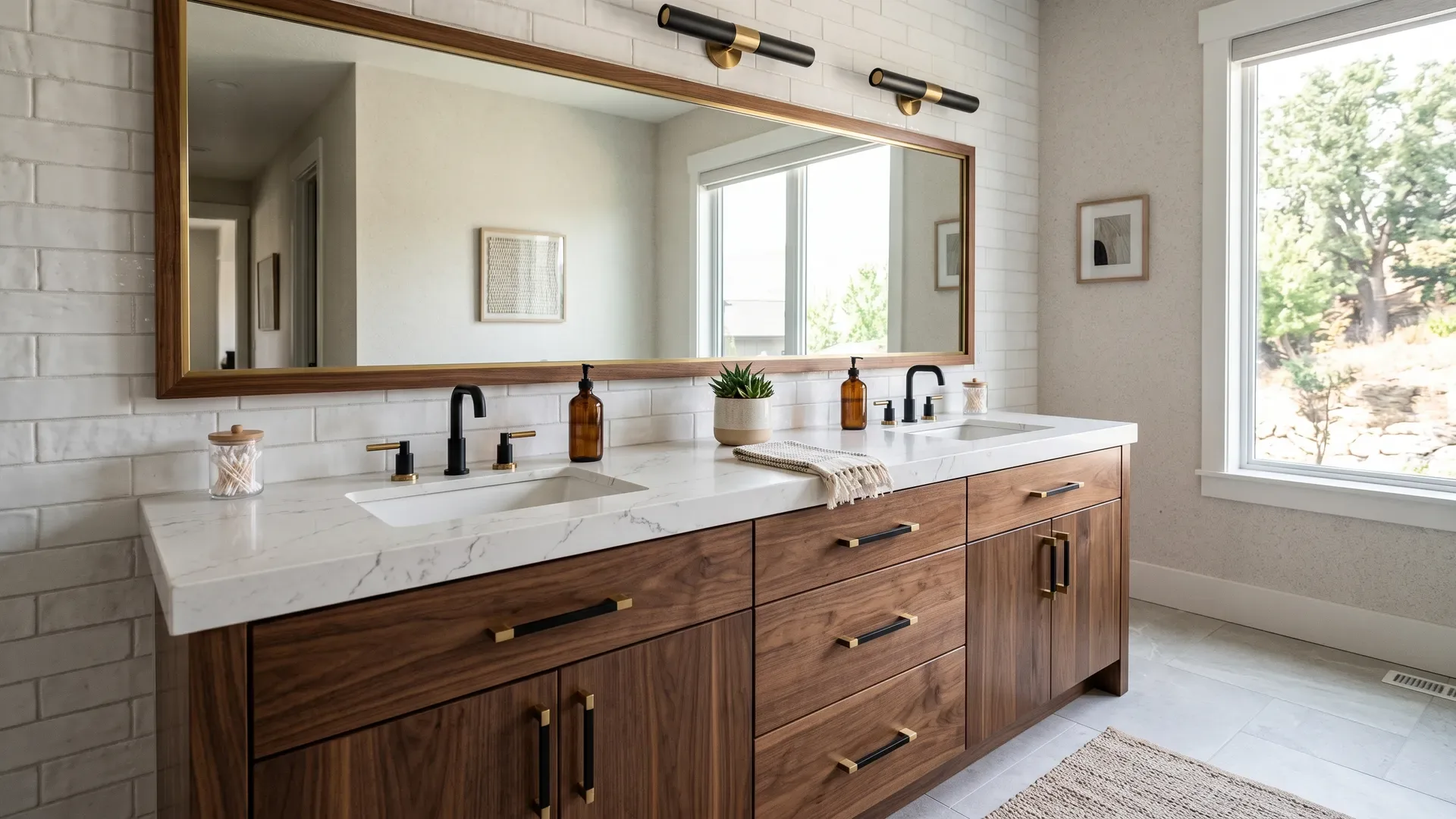
Cabinet hardware is the jewelry of a kitchen: knobs (single-point round or shaped pulls) generally go on doors, and bar or cup pulls go on drawers, though many designers now use pulls everywhere for a consistent, easy-to-grip look. Choose a finish that coordinates (not necessarily matches) your faucet and lighting, and size pulls to roughly one-third the width of the drawer front. Hardware is usually just 3–5% of a cabinet budget but defines how the kitchen feels every day.
Key takeaways: Pulls on drawers, knobs or pulls on doors. Match hardware finish across the room; coordinate (don't perfectly match) with plumbing fixtures. Soft-close is standard on quality cabinets. Buy a few extras for future repairs. See hardware options or plan your project.
Knobs vs pulls: which goes where?
Tap to expand
Knobs vs pulls: which goes where?
The classic rule: knobs on doors, pulls on drawers. It works because drawers are heavier and a horizontal pull gives you a better grip. That said, the modern move is pulls everywhere - consistent, comfortable, and clean. Both are correct; it comes down to your look:
- Knobs on doors + pulls on drawers: classic, a little more traditional, slightly lower cost.
- Pulls on everything: modern, cohesive, easiest to grab with full hands.
- Cup (bin) pulls on drawers + knobs on doors: farmhouse and traditional charm.
How to size cabinet hardware
Tap to expand
How to size cabinet hardware
Sizing is where kitchens look "off" when it's wrong. A good rule: the pull length should be about one-third the width of the drawer front. Small drawers take 3–4 inch pulls; wide drawers look best with long 8–12 inch pulls (or two pulls on very wide fronts). For knobs, 1.25–1.5 inch diameters suit most doors.
| Cabinet part | Typical hardware | Size guide |
|---|---|---|
| Standard door | Knob or 4" pull | 1.25–1.5" knob |
| Small drawer | Pull | 3–4" |
| Wide drawer | Pull (or two) | 8–12"+ |
| Appliance panel | Long bar pull | 12–18" |
Where to place hardware
Tap to expand
Where to place hardware
Consistency is everything. Standard placement:
- Door knobs/pulls: on the stile opposite the hinge, near the top corner for lower cabinets and the bottom corner for uppers.
- Drawer pulls: centered horizontally, centered vertically on the front (or slightly high on tall drawers).
- Use a simple template so every piece lands in the same spot - small inconsistencies are very visible.
Choosing a hardware finish
Tap to expand
Choosing a hardware finish
The big finishes and the feel they give:
- Brushed/satin nickel: warm, forgiving, hides fingerprints - the safe all-rounder.
- Matte black: modern, high-contrast, on-trend; pops on white and sage-green cabinets.
- Brass/champagne bronze: warm and elevated for transitional and classic kitchens.
- Polished chrome: crisp and traditional, but shows spots.
Designer tip: Coordinate, don't perfectly match. Your hardware, faucet, and lighting should share a temperature (all warm or all cool) but they don't need to be identical metals. A matte-black faucet with brushed-nickel pulls can look intentional and layered.
Match hardware to your door style
Tap to expand
Match hardware to your door style
Hardware should echo your door style: simple bar pulls suit Shaker and slab doors; cup pulls and ornate knobs flatter raised-panel and traditional doors. When you order door samples, hold your hardware choices against them in your kitchen's light before finalizing.
Handleless and integrated options
Tap to expand
Handleless and integrated options
Not every kitchen needs visible hardware. Several modern approaches remove or hide it entirely for a seamless look that pairs beautifully with frameless slab cabinets:
- Edge / finger pulls: a routed channel or a slim pull along the top edge of the door and drawer - clean and easy to grab.
- Integrated (J-pull) profiles: the door itself is shaped to create a grip, so there is no separate piece.
- Push-to-open: a light press releases the door or drawer; ideal for a truly hardware-free front, though it needs quality mechanisms to feel right.
Handleless looks stunning in photos, but consider daily life: kids, messy hands, and heavy drawers. Many Treasure Valley families choose a hybrid - handleless on uppers, discreet pulls on the hardest-working base drawers.
Mixing metals the right way
Tap to expand
Mixing metals the right way
Mixing finishes is not only allowed, it is what makes a kitchen look designed rather than ordered from a catalog. The trick is a little structure:
- Pick a dominant metal for the cabinet hardware (say, brushed nickel or matte black).
- Let the faucet or lighting be the accent in a second finish, ideally sharing a temperature (warm-with-warm, cool-with-cool).
- Repeat each metal at least twice so it looks intentional - for example, matte-black pulls echoed in the pendant lights.
A warm brass faucet over a sink with matte-black cabinet pulls and black pendants is a classic, layered combination that photographs and lives beautifully.
Cabinet hardware trends
Tap to expand
Cabinet hardware trends
What is moving in Treasure Valley kitchens right now:
- Matte black remains the leading modern choice, especially on white and sage-green cabinets.
- Warm metals - champagne bronze, aged brass, and unlacquered brass that patinas over time - are rising for transitional and classic kitchens.
- Longer pulls, including full-height appliance and pantry pulls, for a bold, architectural line.
- Mixed metals as a deliberate design choice rather than an accident.
- Knurled and fluted textures for tactile detail on knobs and pulls.
Hardware and accessibility
Tap to expand
Hardware and accessibility
If anyone in your home has limited grip or hand strength, hardware choice matters for comfort and independence. D-shaped and bar pulls are far easier to use than small round knobs, because you can hook a few fingers or even a wrist through them. Pulls on both doors and drawers, mounted so they are easy to reach, make a kitchen work for every age - a small decision with a big daily payoff, and a smart one for aging-in-place planning.
How much does cabinet hardware cost?
Tap to expand
How much does cabinet hardware cost?
Hardware typically runs 3–5% of a cabinet budget, but the range is wide: basic knobs and pulls can be a few dollars each, while designer solid-brass or specialty pieces run $15–$40+ each. A typical kitchen needs 30–50 pieces, so the choice adds up. Because it is one of the easiest details to change later, some homeowners start modest and upgrade over time - but buying quality once usually feels better every day. For how hardware fits the overall number, see the Boise cabinet cost guide.
Hardware selection checklist
Tap to expand
Hardware selection checklist
- ☐ Decide knobs-and-pulls vs pulls-everywhere vs handleless
- ☐ Choose a dominant finish; plan any accent metal to coordinate by temperature
- ☐ Size pulls to ~1/3 the drawer width; use long pulls on wide fronts
- ☐ Confirm consistent placement with a template
- ☐ Prioritize easy-grip pulls if accessibility matters
- ☐ Order a few extra pieces for future exact-match repairs
Don't forget the hardware you don't see
Tap to expand
Don't forget the hardware you don't see
Hinges and drawer glides matter as much as the pulls. Quality cabinets use six-way adjustable, soft-close concealed hinges and full-extension, soft-close undermount glides so doors and drawers close quietly and stay aligned for years. It's one of the clearest signs of a well-built cabinet - ask about it in any quote. See our construction standards.
Hardware materials that last
Tap to expand
Hardware materials that last
Two pulls can look identical in a photo and feel worlds apart in your hand. Material is why:
- Solid brass: heavy, durable, and ages gracefully; the premium choice, and worth it on the pieces you touch most.
- Stainless steel: tough and corrosion-resistant, great for a clean modern look.
- Zinc alloy (die-cast): the budget standard - fine for light-use doors, but can feel hollow and wear at the plating over years.
A smart strategy is to invest in solid-metal pulls on the hardest-working base drawers and save on lightly used upper-door knobs. Heft, a smooth finish, and secure screws are the tells of quality you can feel in the showroom.
Coordinating hardware beyond the kitchen
Tap to expand
Coordinating hardware beyond the kitchen
Cabinetry rarely stops at the kitchen. For a home that feels custom rather than piecemeal, carry your hardware language into the bathroom vanities, laundry room, mudroom, and built-ins. You do not have to use the identical pull everywhere - but keeping the same finish and a consistent style family ties the whole home together. Many homeowners use the exact kitchen pull in the primary bath and a coordinating knob elsewhere, so each space feels connected without being a copy.
Putting it all together
Tap to expand
Putting it all together
Hardware is the smallest line on your cabinet quote and one of the largest influences on how the finished kitchen feels in your hands every day. The decisions compound: the door style suggests a shape, the finish suggests a temperature, your household suggests how easy the grip needs to be, and your budget decides how far the material goes. Get those four in agreement and the hardware disappears into a kitchen that simply works - drawers that glide, doors that close with a quiet touch, and pulls that feel substantial and consistent from one end of the room to the other. Get them out of sync and even beautiful hardware feels a little off. The good news is that this is one of the most forgiving decisions to plan well and, if you ever want a refresh, one of the easiest to change. Our designers help Treasure Valley homeowners choose hardware alongside the door and finish so the whole package reads as one intentional design, then install it with the soft-close hinges and glides that make quality obvious the first time you open a drawer. In a home you will live in and love for years, that everyday feel in your hands is worth getting right the first time.
Hardware, planned with your cabinets
Tap to expand
Hardware, planned with your cabinets
Boise Cabinet Co helps homeowners across Boise, Meridian, Eagle, and Nampa choose and place hardware as part of the design, not an afterthought. Browse hardware collections, coordinate with your door style and finish, then get a planning range or book a free consultation. Tip: order a few extra pieces so a future replacement is an exact match.