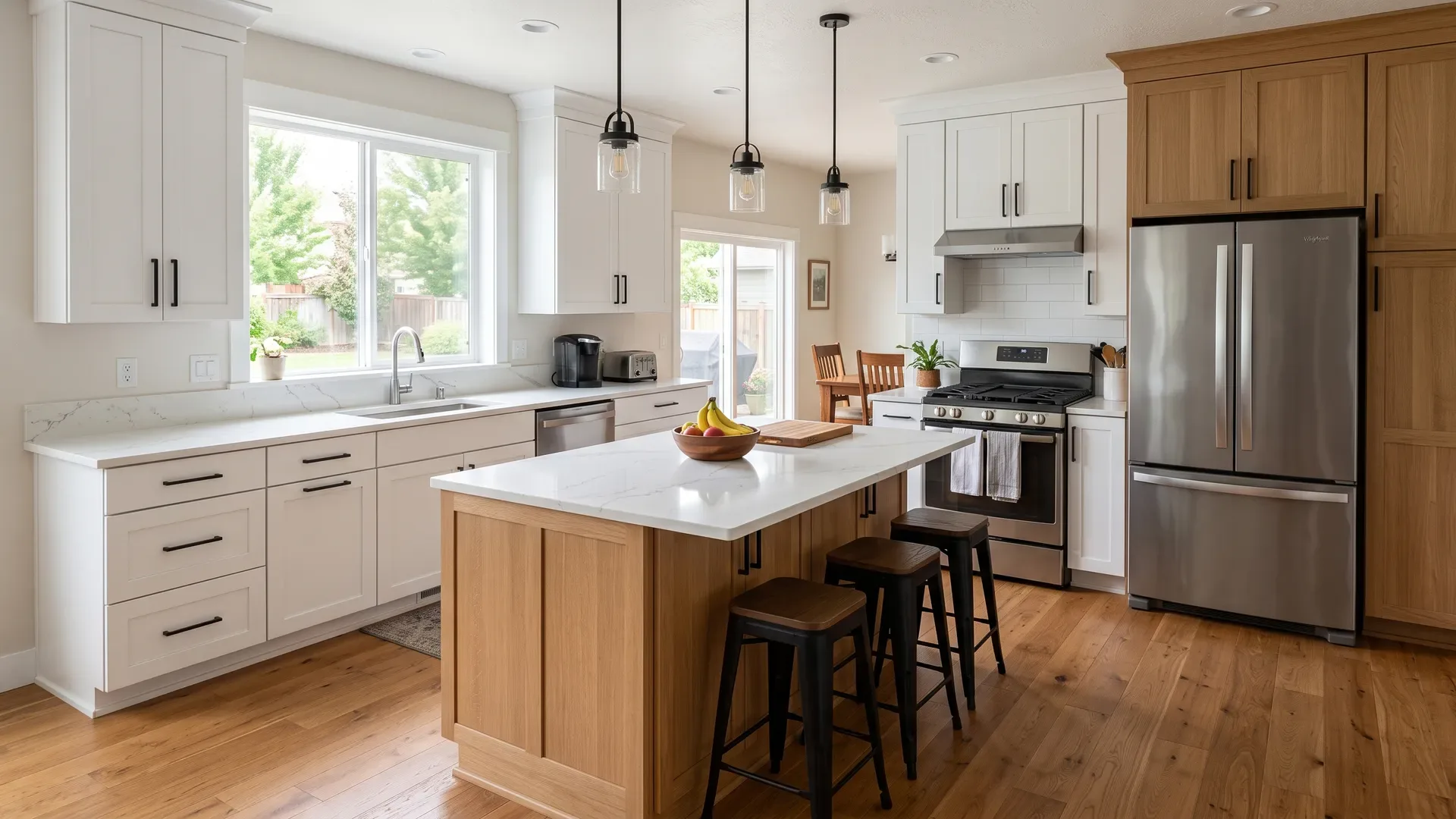
Cabinet cost per linear foot is a rough pricing shorthand: you measure the total length of cabinet runs (in feet) and multiply by a per-foot rate. In the Boise area, custom cabinets commonly land in the range of $300 to $900+ per linear foot installed, depending on construction, finish, and accessories. It is useful for a ballpark, but it can mislead, because two kitchens of the same length can cost very differently based on drawers, specialty cabinets, and finish. Treat it as a starting estimate, not a quote.
Key takeaways: Per-linear-foot is a ballpark, not a bid. Measure your runs, multiply by a rate, but know that drawers, tall/specialty cabinets, finish, and accessories swing the real number. For an accurate figure, you need a design and a written scope. Get a planning range in about a minute.
What "per linear foot" actually measures
Tap to expand
What "per linear foot" actually measures
A linear foot is one foot of horizontal cabinet run measured along the wall, regardless of height. To estimate, you add up the lengths of your base cabinets (and often count wall cabinets separately or bundle them into the rate). A galley kitchen with 20 feet of cabinets at $500 per foot pencils out to roughly $10,000 for cabinetry - as a starting point. The method is popular because it is quick and lets you compare rough scope, but it flattens a lot of important detail into a single number.
Why the per-foot number varies so much
Tap to expand
Why the per-foot number varies so much
The same 20 feet can cost wildly different amounts. Here is what moves it:
- Drawers vs doors: a bank of dovetailed drawers costs more than a simple door-and-shelf cabinet of the same width.
- Tall and specialty cabinets: pantries, appliance garages, and corner solutions cost more per foot than standard bases.
- Construction: plywood boxes and soft-close everything cost more than particleboard and basic hardware - see construction quality.
- Finish: a painted or specialty finish typically costs more than a basic stain - see finishes in the catalog.
- Door style and hardware: inset and intricate profiles and premium hardware add up.
- Install complexity: odd walls, tall ceilings, and tricky layouts take more labor.
Rough per-linear-foot ranges in the Treasure Valley
Tap to expand
Rough per-linear-foot ranges in the Treasure Valley
| Tier | Rough range (installed) | What you get |
|---|---|---|
| Stock / entry | $150–$300/ft | Fixed sizes, basic construction |
| Semi-custom | $300–$550/ft | More options, better build |
| Custom | $500–$900+/ft | Exact fit, premium construction and finish |
These are planning ranges, not quotes - your actual number depends on the mix above. Use them to sanity-check a budget, then confirm with a real design.
How to estimate your project
Tap to expand
How to estimate your project
- Measure the total length of your base cabinet runs in feet.
- Pick a per-foot rate for your tier from the table above.
- Multiply for a rough cabinetry figure.
- Add for tall/specialty cabinets, an island, and premium finish or hardware.
- Remember countertops, appliances, and other trades are separate.
Faster and more accurate: our online estimator turns your room, size, and style into a planning range in about a minute - no measuring math required - and it accounts for the details a flat per-foot rate can't.
Where per-foot pricing misleads
Tap to expand
Where per-foot pricing misleads
Be careful using per-linear-foot to compare two companies. One quote's "$400 per foot" might include plywood boxes, soft-close everything, and a painted finish, while another's includes particleboard and basic hardware. The rate looks similar; the cabinets are not. Always compare what is actually in the price - construction, finish, and included accessories - rather than the headline number. A slightly higher per-foot rate with better construction is usually the better long-term value.
What the number leaves out
Tap to expand
What the number leaves out
Per-linear-foot pricing covers the cabinetry, but a kitchen project has more: countertops, sink and faucet, backsplash, appliances, lighting, and any electrical or plumbing changes. When you set a budget, hold the cabinet number in one bucket and these related costs in another so nothing surprises you. For the full local picture, the Boise cabinet cost guide breaks down every line.
Base cabinets, wall cabinets, and the math
Tap to expand
Base cabinets, wall cabinets, and the math
One reason per-linear-foot estimates confuse people is that companies count them differently. Some quote a single rate that bundles base and wall cabinets together for a typical run. Others price base and wall cabinets separately, since a wall of both costs more per floor-foot than base cabinets alone. When you compare rates, ask exactly what the number includes: is it base only, base plus wall, and does it cover the toe-kick, fillers, and finished end panels? A rate that looks low may simply be counting less. The most honest way to compare is to have each company price the same drawn layout, so you are measuring the same thing rather than two different definitions of a foot.
How islands and specialty pieces change the number
Tap to expand
How islands and specialty pieces change the number
An island can quietly double the cabinetry in a kitchen while adding little wall length, so it breaks the per-linear-foot shortcut. Islands often carry drawers on one side, seating overhang and finished panels on the other, and sometimes a sink or cooktop cutout - all of which add cost that a simple wall measurement misses. The same goes for tall pantries, appliance panels that hide the dishwasher or fridge, glass-front display cabinets, and clever corner solutions. Each of these is worth the money for the function it adds, but each also nudges your true cost above a flat per-foot figure. When you sketch a budget, list these specialty pieces separately so they are not lost in the averages.
Rough examples by kitchen size
Tap to expand
Rough examples by kitchen size
To make the ranges tangible, here is how the math tends to look for custom cabinetry in the Treasure Valley. These are planning illustrations, not quotes:
- Small kitchen (~15 linear feet): at roughly $500–$700 per foot, cabinetry lands around $7,500–$10,500, before an island or premium finishes.
- Mid-size kitchen (~25 linear feet): at a similar rate, roughly $12,500–$17,500, with a modest island pushing it higher.
- Large kitchen (~35+ linear feet with an island): often $20,000–$30,000+ for custom cabinetry, driven by drawer banks, tall cabinets, and finish.
Notice how quickly finish and specialty pieces move these numbers - which is exactly why a real design beats a per-foot guess. Our estimator turns your specific room and choices into a range in about a minute.
What a real written quote includes
Tap to expand
What a real written quote includes
When you move from ballpark to a firm number, a good quote spells out far more than a rate. It should list the door style and finish, the box and drawer construction, the hinge and glide hardware, every cabinet by size and type, specialty pieces and accessories, delivery, and installation scope. That level of detail is what lets you compare two companies fairly and understand exactly what you are buying. If a quote is just a lump sum or a bare per-foot figure with no breakdown, ask for the detail - the transparency itself is a sign of how the company works. For how we structure a written scope before any fabrication begins, see how we build.
The bottom line
Tap to expand
The bottom line
Cost per linear foot is a helpful first sketch of your cabinet budget - quick, easy, and good for a gut check. But it is a starting point, not a finish line. The real number comes from your actual layout, the mix of drawers and specialty cabinets, the construction you choose, and the finish and hardware you love. When you are ready for a figure you can plan around, a short guided estimate or an in-home design visit will get you there far more accurately than any per-foot rule of thumb.
Getting the most value per foot
Tap to expand
Getting the most value per foot
If you want your budget to go further, the smartest move is to spend where you touch and skimp where you do not. Put your money into construction and into the cabinets you use most - the base drawers by the range, the pantry, the everyday doors - and be more economical on cabinets that see light duty or hide behind other things. A modest, timeless door style with a great box will feel more expensive over the years than a fancy profile on a flimsy box. You can also control cost by keeping the layout efficient: every extra corner, angle, and specialty cabinet adds dollars per foot, so a clean, well-planned run stretches the budget. And because finish is one of the larger swing factors, choosing a beautiful but standard finish over an exotic one frees up budget for the construction that actually determines how long the kitchen lasts.
Some homeowners also phase the work: investing in quality cabinets now and adding accessories, an island upgrade, or a specialty piece later. That approach lets you buy the bones right the first time without stretching for every extra at once. Whatever path you choose, the goal is the same - a number you understand, built from your real layout and choices rather than a rule of thumb. A short conversation with a designer will turn your rough per-foot sketch into a plan you can actually budget around, and it costs you nothing to find out where your project truly lands. Even a quick online estimate will show you how your specific layout, finishes, and accessories reshape the per-foot math, which is the fastest way to trade a rough rule of thumb for a real, plannable number for your Treasure Valley kitchen.
Get an accurate cabinet estimate
Tap to expand
Get an accurate cabinet estimate
Boise Cabinet Co gives Boise, Meridian, Eagle, and Nampa homeowners a real planning range and a written scope - not just a per-foot guess. Try the online estimator, read the cost guide, or book a free in-home consultation and we will measure, plan, and price your kitchen or bath accurately, with a written scope and an honest range you can actually plan around.